What a day! Started with a great session about the movie Surf's Up, which I am so gonna see now when it comes out on DVD in October. It's a computer animated movie that was created as a documentary. They did everything from adding scratches to the "lens" you'd see while watching, to looking at how each character interacted with the camera, to actually making the camera itself a character.
To make the camera a character, they rigged it up with a motion-capture device and a little screen for a viewfinder. A real camera person would hold the camera and watch what was happening by looking through the viewfinder, which showed a 3D view of the characters interacting and the environment. The cameraman's movement was recorded and then brought into the movie, making it extremely realistic. It's like watching a reality tv show, but it's animated!
The movie was about surfing, so a large part of the presentation was about how they did the ocean, and more specifically the waves. They put a massive amount of work into the waves, and it all paid off, because they look AMAZING. Check out the preview on IMDB and you'll see it.
After lunch I went to a session called "Sharing Ideas in Teaching 3D Animation", which was interesting and helpful. It really made me think about not just how to teach this stuff, but how the students might understand it better. There is so much to learn when it comes to computer animation. Do you teach the technical stuff (the software) during class, or just talk the concepts (camera positions, basics, animation theory) during that time? Much to think about!
I then ran all the way across the convention center to watch Glenn Entis, the Chief Visual and Technical Officer of ALL of Electronic Arts speak. He gave a good talk about graphics, games, and the tools to create them, from way back in 1979 until today. In the end, the basic premise was that the new "wow" of games right now is user-created content. He mentioned The Sims, which he said is actually the best-selling game of all time, and that the biggest draw of it turned out not to be playing the characters but the creation of your own objects in the game. He also mentioned Spore, which will be hugely user-changeable. It's all about the tools, and if normal game players / users can use the tools to create their own stuff, they are going to have fun and really get into it.
Then I ran all the way back across the convention center to the Blender Artist and Developer Showcase, which was really cool. I saw and heard Ton Roosendaal, the creator of Blender (and got a picture of him... I'll post it soon!), and a bunch of the people I read about and see the work of on all the Blender websites. The director of Elephant's Dream was there, showing his latest work - very impressive stuff. Some great developments will be coming soon from Blender!
Right now I'm sitting in the session for Happy Feet. They took almost the direct opposite (and yet strangely similar) approach of Surf's Up. This movie, also featuring penguins, was also shot as if it had real people, but for this one it was directed like a normal movie. The director had no experience with animated movies, and managed to make it as if it were real "people" (penguins) doing the acting. They made it a really iterative process, which is unusual for an animated movie, because once you get the animation done it's difficult to get back in and change things. They also made very heavy use of motion capture, which as I said above Surf's Up almost didn't use at all. They actually had real people learn to walk like penguins and do all the acting!
And that's all I did today! I took more pictures today, and also still have some from yesterday, so I'll post them soon.
Monday, August 6, 2007

Why I Love Coming to Siggraph
This morning, just now, on my way to the session on the movie "Surf's Up" (The Making of Animated Documentary), I overhear one person saying to another,
"So, I was the visual effects supervisor on Spider-Man 3, umm, yeah."
To some, eh, whatever. To me, WOO HOO!!
"So, I was the visual effects supervisor on Spider-Man 3, umm, yeah."
To some, eh, whatever. To me, WOO HOO!!
Sunday, August 5, 2007
Siggraph 2007 Day 1 (even more continued)
The OpenGL course today was incredible! The three presenters literally wrote the books on OpenGL programming. One of them, Ed Angel, wrote the book I used in my computer animation class back at WPI! They gave a great introduction to OpenGL, which served to refresh my brain on much of what I've forgotten the past few years. Plus, for the second half, they brought out some more of the advanced features you can implement, such as shaders. It was great, and will help me for sure in my own graphics programming. At the end I was even able to ask a question directly to one of the presenters about something I had read online. He refuted it, so I was glad to ask! (for those wondering, the question was about glut)
After that I attended the Fast-Forward Papers session, which was quite good. They had every single paper presenter (must have been like 100 people) do a 50-second synopsis of their research up on a stage with a few powerpoint slides. The range of different presentations was amazing. Some had videos to show, some just read about what they were doing with a few words on the screen, some got all dressed up in some funny clothes, and a couple even wrote little poems about their research! It was funny and interesting. A few had people in the audience going "ooooh" and "wow" and clapping even during the 50 seconds. I was pretty amazed at some of them, and maybe will try to get into their real paper presentation whenever they do it in the next four days.
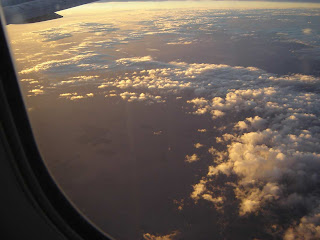
And, as promised, some more pictures! First, two gorgeous shots of the sunset from the plane just before landing in San Diego:

Here's my room at the Mission Valley Resort, and a bunch of pictures from the outside.


Tomorrow I'll put up some pictures of the convention center and the view outside of it, which is quite nice. It's right on the water in the harbor. Until then, goodnight! The day begins early tomorrow...
After that I attended the Fast-Forward Papers session, which was quite good. They had every single paper presenter (must have been like 100 people) do a 50-second synopsis of their research up on a stage with a few powerpoint slides. The range of different presentations was amazing. Some had videos to show, some just read about what they were doing with a few words on the screen, some got all dressed up in some funny clothes, and a couple even wrote little poems about their research! It was funny and interesting. A few had people in the audience going "ooooh" and "wow" and clapping even during the 50 seconds. I was pretty amazed at some of them, and maybe will try to get into their real paper presentation whenever they do it in the next four days.
And, as promised, some more pictures! First, two gorgeous shots of the sunset from the plane just before landing in San Diego:


Here's my room at the Mission Valley Resort, and a bunch of pictures from the outside.


Tomorrow I'll put up some pictures of the convention center and the view outside of it, which is quite nice. It's right on the water in the harbor. Until then, goodnight! The day begins early tomorrow...
Siggraph 2007 Day 1 (continued)
Found a little time (and a power plug) before the openGL course starts, so I'm going to post some pictures of the flight :-) I'll admit some of them are just for my son, he loves interesting vehicles! Here they are with some comments (click on them for a larger version):
 Here's the plane about to take me from Bradley to Atlanta, ready to be boarded!
 This is the little train of cars carrying everyone's luggage. This one is at Bradley, but in Atlanta, they were everywhere. It was like hundreds of little centipedes crawling all over the tarmac carrying their baggage with them! They even had their own tunnel under the concourse.

Here's a neat-looking fuel truck for the planes. It's all gas tank!
 Here is the guy putting luggage onto the plane (my seat was right above the cargo door!). I'll say I was a tiny bit nervous, because I didn't see my actual bag going up the ramp. I ended up getting it, so it made it to the plane somehow :-) I'm glad I wasn't out there throwing people's luggage around - it was HOT.
 This is what Connecticut looks like from I think about 15,000 feet. Landscapes from a plane are just amazing!
 A great shot from the plane window of some downright inspirational clouds, somewhere between Connecticut and Georgia. I was watching a movie on my laptop (The Illusionist - which was very, very good, but that's for another post), and just happened to look out the window at the right time to see this.
 This is the plane that is waiting to take me from Atlanta to San Diego. This airport is HUGE.
 Here is the inside of the plane going to San Diego. The last time I was in a plane this large, we were going all the way to Israel. The in-flight movie was Spider-Man 3, which was awesome. It was also absolutely perfect, because I hadn't yet seen the movie and I'm going to a session about the special effects in it here at Siggraph!
Alright, it's 1:45 and time for the openGL graphics programming intro course. More pictures to come!
 Here's the plane about to take me from Bradley to Atlanta, ready to be boarded!
 This is the little train of cars carrying everyone's luggage. This one is at Bradley, but in Atlanta, they were everywhere. It was like hundreds of little centipedes crawling all over the tarmac carrying their baggage with them! They even had their own tunnel under the concourse.
Here's a neat-looking fuel truck for the planes. It's all gas tank!
 Here is the guy putting luggage onto the plane (my seat was right above the cargo door!). I'll say I was a tiny bit nervous, because I didn't see my actual bag going up the ramp. I ended up getting it, so it made it to the plane somehow :-) I'm glad I wasn't out there throwing people's luggage around - it was HOT.
 This is what Connecticut looks like from I think about 15,000 feet. Landscapes from a plane are just amazing!
 A great shot from the plane window of some downright inspirational clouds, somewhere between Connecticut and Georgia. I was watching a movie on my laptop (The Illusionist - which was very, very good, but that's for another post), and just happened to look out the window at the right time to see this.
 This is the plane that is waiting to take me from Atlanta to San Diego. This airport is HUGE.
 Here is the inside of the plane going to San Diego. The last time I was in a plane this large, we were going all the way to Israel. The in-flight movie was Spider-Man 3, which was awesome. It was also absolutely perfect, because I hadn't yet seen the movie and I'm going to a session about the special effects in it here at Siggraph!
Alright, it's 1:45 and time for the openGL graphics programming intro course. More pictures to come!
Siggraph 2007 Day 1
Well, here I am! San Diego is a beautiful city, and even the convention center looks great. The architecture around here is like nothing I've seen before. I'll take many pictures! There are thousands of people walking around, and excitement is in the air. I can hear many languages, and I see a lot of diversity (though admittedly the geeks, whatever country they're from, outnumber everyone else!).
Right at this moment I'm sitting in a huge room where four people from Pixar are explaining the concepts and challenges of representing food in their newest movie, Ratatouille. I got here just in time for the break (so I can write this post!), and will be able to catch the second half.
Alright, just watched the second half. The speaker was the manager of the effects department at Pixar, and he did a really good job explaining the challenges of food in computer animation. There are many to say the least! Everything, from steam on hot food, to scum on the inside of soup pots, to stains on a chef's clothes has to be explicitly created. And to do it, they cheated - a lot! When it comes to feature film animation, it's something you absolutely have to do, or your movie will never be finished.
One funny example was when they tried to simulate a sauce coming out of a pan and pouring onto some bread on a plate. The sauce would either take too long to pour out, or be too watery. Also, once it reached a certain threshold of pouring, it would just snap, and a big amount would stay in the pan, while the rest just plopped to the plate. What they ended up doing was literally reducing the pull of gravity when the sauce began to pour, then ramped it up as it poured onto the plate. To solve the snapping problem, they created extra sauce as particles - the whole thing changes from one CG object to another and you don't even notice. One of their programmers needed to create a new in-house piece of programming to be able to accomplish it. Amazing!
So, right now I'm eating a delicious lunch under a huge sunlit tent-like structure between the two massive buildings of the convention center. Later today, after getting back to my hotel room, I'll post some pictures of the flights (I took some incredible ones out of the airplane window) and the area of the hotel. I'm going to finish my lunch and then check out the book store before the next course. Great day so far!
Right at this moment I'm sitting in a huge room where four people from Pixar are explaining the concepts and challenges of representing food in their newest movie, Ratatouille. I got here just in time for the break (so I can write this post!), and will be able to catch the second half.
Alright, just watched the second half. The speaker was the manager of the effects department at Pixar, and he did a really good job explaining the challenges of food in computer animation. There are many to say the least! Everything, from steam on hot food, to scum on the inside of soup pots, to stains on a chef's clothes has to be explicitly created. And to do it, they cheated - a lot! When it comes to feature film animation, it's something you absolutely have to do, or your movie will never be finished.
One funny example was when they tried to simulate a sauce coming out of a pan and pouring onto some bread on a plate. The sauce would either take too long to pour out, or be too watery. Also, once it reached a certain threshold of pouring, it would just snap, and a big amount would stay in the pan, while the rest just plopped to the plate. What they ended up doing was literally reducing the pull of gravity when the sauce began to pour, then ramped it up as it poured onto the plate. To solve the snapping problem, they created extra sauce as particles - the whole thing changes from one CG object to another and you don't even notice. One of their programmers needed to create a new in-house piece of programming to be able to accomplish it. Amazing!
So, right now I'm eating a delicious lunch under a huge sunlit tent-like structure between the two massive buildings of the convention center. Later today, after getting back to my hotel room, I'll post some pictures of the flights (I took some incredible ones out of the airplane window) and the area of the hotel. I'm going to finish my lunch and then check out the book store before the next course. Great day so far!
Tuesday, July 24, 2007
Wow
Two things to mention in this post, and both are truly original and inspiring (at least to me!). Both are straight out of Japan.
First, I heard about a new puzzle game coming out for the PS3 that's supposed to be very different. It's called Echo Chrome. Here's a link to it's preview video on YouTube. The first time I saw that, I said just "wow" out loud - somewhere there's a developer with a very twisted mind! The great part is that the original idea, or at least one who took the idea to the extreme, was from M.C. Escher. Making an animated, changeable, puzzle game out of it is quite outside the box.
Anyway, after a little more searching, I found the website of the original developer of the idea, and it turns out you can play around with the original system online! Scroll to the bottom of that page, and there's a link to download it for the PC, or even play it online in a Java applet. It's mind-bending to say the least.
The other thing that has me excited is a video called Missing Pages. I recommend it to everyone! You can download it for free or watch it on YouTube. There's an interview with the guy who wrote and directed it at CGChannel. The way in which the "movie" was put together is creative and somewhat different, like those 3d pictures you see on History channel documentaries sometimes. It's all photos, 3D compositing, and some animation - almost like an animated comic book.
The film really makes me want to load up Shake again and play around with it - I'll need to make some time for that before the summer is out! Sure, he used After Effects, but they can both do the same effects.
First, I heard about a new puzzle game coming out for the PS3 that's supposed to be very different. It's called Echo Chrome. Here's a link to it's preview video on YouTube. The first time I saw that, I said just "wow" out loud - somewhere there's a developer with a very twisted mind! The great part is that the original idea, or at least one who took the idea to the extreme, was from M.C. Escher. Making an animated, changeable, puzzle game out of it is quite outside the box.
Anyway, after a little more searching, I found the website of the original developer of the idea, and it turns out you can play around with the original system online! Scroll to the bottom of that page, and there's a link to download it for the PC, or even play it online in a Java applet. It's mind-bending to say the least.
The other thing that has me excited is a video called Missing Pages. I recommend it to everyone! You can download it for free or watch it on YouTube. There's an interview with the guy who wrote and directed it at CGChannel. The way in which the "movie" was put together is creative and somewhat different, like those 3d pictures you see on History channel documentaries sometimes. It's all photos, 3D compositing, and some animation - almost like an animated comic book.
The film really makes me want to load up Shake again and play around with it - I'll need to make some time for that before the summer is out! Sure, he used After Effects, but they can both do the same effects.
Sunday, July 22, 2007
Bring on the inspiration!
I've seen and heard quite a bit lately that has caused my imagination to soar!
First, there was a documentary we checked out from the local library (quick side note: the library is loaded with more documentaries than you can shake a stick at... for FREE!). The one I picked was a NOVA documentary about "The Mysterious Life of Caves." There were a couple things that really stuck out for me, and one was that acid drips from the walls and ceilings. Acid drips from the walls and ceilings. Just think about that.
These three scientists figured out that there is a bacteria growing in some caves that literally melt the rock wall away to create the cave itself. They don't use sunlight at all (it's totally black dark in the caves) - they only feed on gas in the cave and the rock itself, manganese in particular.
Another set of scientists in another cave had discovered bacteria growing in water and acid, without the use of sunlight at all, and that they were related to the bacteria growing near deep-sea vents in the ocean. They say these organisms are probably related to the original life on the planet, i.e. where not just us humans, but all life on Earth came from. Awesome.
Moving on, I read an article on Gamers with Jobs about directing and camera work in games. It reminded me of a great game I played years back called Anachronox, which I remember even back then thinking about how great the camera moves were. They had really put a lot of thought into it, and it made the game that much better. It was really one of the best games I've ever played (I'd put it in my top 5 of all time), and just thinking about it makes me want to play it again. I've posted on the Gamers with Jobs game trading thread, so hopefully someone has it and wants to trade... I've unfortunately lost the game due to throwing it away or placing it somewhere in my parent's basement.
Speaking about directing and camera work in games, it's something I've already thought quite a bit about for my own game. Here are some lines from my notes:
On a somewhat unrelated note, I've been reading a book called "In Praise of Slowness" by Carl Honore. I saw it at the library and couldn't help but check it out. It turns out that there is a huge movement worldwide to practice the power of Slow. Those that know me well know that I'm not exactly the fastest person in the world, and it looks like I've been right all this time (haha)!
Check out this wikipedia entry about the Slow Movement. It's not just about moving slower, it's a philosophy on life, and I love it. Reading this book has really brought my attention to how fast the world, and especially our society, is trying to make everyone get things done. It's causing more stress, health problems, and costing more money than people realize. I'm only a few chapters into the book right now, but I'll post more as I read more.
This is a long post and I'm done!
First, there was a documentary we checked out from the local library (quick side note: the library is loaded with more documentaries than you can shake a stick at... for FREE!). The one I picked was a NOVA documentary about "The Mysterious Life of Caves." There were a couple things that really stuck out for me, and one was that acid drips from the walls and ceilings. Acid drips from the walls and ceilings. Just think about that.
These three scientists figured out that there is a bacteria growing in some caves that literally melt the rock wall away to create the cave itself. They don't use sunlight at all (it's totally black dark in the caves) - they only feed on gas in the cave and the rock itself, manganese in particular.
Another set of scientists in another cave had discovered bacteria growing in water and acid, without the use of sunlight at all, and that they were related to the bacteria growing near deep-sea vents in the ocean. They say these organisms are probably related to the original life on the planet, i.e. where not just us humans, but all life on Earth came from. Awesome.
Moving on, I read an article on Gamers with Jobs about directing and camera work in games. It reminded me of a great game I played years back called Anachronox, which I remember even back then thinking about how great the camera moves were. They had really put a lot of thought into it, and it made the game that much better. It was really one of the best games I've ever played (I'd put it in my top 5 of all time), and just thinking about it makes me want to play it again. I've posted on the Gamers with Jobs game trading thread, so hopefully someone has it and wants to trade... I've unfortunately lost the game due to throwing it away or placing it somewhere in my parent's basement.
Speaking about directing and camera work in games, it's something I've already thought quite a bit about for my own game. Here are some lines from my notes:
- Extreme slow motion, with a lot going on during it (stuff flying around... hey, maybe snow falling!).
- Alternate seamlessly between extreme slow motion and normal or fast.
- Long uncut shots - very cool and adds to tension and believability.
- Add to it by bringing the camera through tiny cracks in walls or door locks, etc.
- Many "impossible" shots - flying over and around stuff, through stuff, go from real high in the sky to real low.... maybe even underground or underwater.
On a somewhat unrelated note, I've been reading a book called "In Praise of Slowness" by Carl Honore. I saw it at the library and couldn't help but check it out. It turns out that there is a huge movement worldwide to practice the power of Slow. Those that know me well know that I'm not exactly the fastest person in the world, and it looks like I've been right all this time (haha)!
Check out this wikipedia entry about the Slow Movement. It's not just about moving slower, it's a philosophy on life, and I love it. Reading this book has really brought my attention to how fast the world, and especially our society, is trying to make everyone get things done. It's causing more stress, health problems, and costing more money than people realize. I'm only a few chapters into the book right now, but I'll post more as I read more.
This is a long post and I'm done!
Subscribe to:
Posts (Atom)